Last time I was not so succesfull with my participation at Matt Granger’s (ThatNikonGuy) photocompetition. But it’s always fun to participate. So I do it again. This time actually is a bit different. I started making timelapses, which despite usually done by photographers are videos. It’s really a lot of work. So despite haven taken the standard red blossom and red chili amongst many green on the plant I wanted to upload my timelapses. This took me several hours to get them this far. I wonder a bit why no one submits videos. I checked, they are allowed. So now I’m really curious about the feedback. You can see the video here:
The last one got 505 view, 1 like, 0 comments. Let’s see how this one does.
If you want to see the other participants in Matt Granger’s photocompetition for august, just click here.
And here a preview picture of the video:
A screenshot from my video participation to Matt Granger’s photocompetetion in august 2014.
If looking at the seed packets I bought, germination times are usually 1-3 weeks. The first ones are often a bit faster. Now I found seeds that are the opposite. From the marigold (calendula officinalia) seeds I put out end of april one (!) was germinating one week ago. It was a huge bunch of seeds, when I put all my leftovers in the soil. Obviously not much living there and even the only one who survived took quite a while to come out. I didn’t expect that it’s possible to germinate so slow. Maybe there’s a state between alive and dead for seeds also – not only for Schrödinger’s cat.
In Villach hört man viele Gerüchte um die Radioaktivität des Maibachl. Einige Leute sagen es sei sogar gesund. Sucht man nach dem Wasser des Maibachls in Villach, so findet man immer die gleichen Informationen. Es sprudelt mit 28°C aus der Erde, ist hart durch seinen Mineralienreichtum um enthält Spuren von Radon. Wieviel? Das schreibt niemand. Man muss schon etwas in alten Dokumenten stöbern und so richtig schlau wird man auch nicht. Aber vor langer Zeit wurden bei Fischkrankheitsuntersuchungen auch Messungen durchgeführt, wieviele radioaktive Stoffe im Maibachl sind. Die Veröffentlichung ist vermutlich 50 Jahre alt, denn sie zitiert Werke bis 1963.
1963 gemessene Wasserwerte und Radioaktivität des Maibachl Villach
Leider ist mir die Einheit c unbekannt. Handelt es sich um das Curie (richtig abgekürzt: Ci)? Dann entspräche die Radonaktivität ziemlich genau einem Becquerel. Hier hätten wir also einen Radonzerfall pro Liter und Sekunde. Das ist schon sehr wenig und es ist fraglich, ob das damals nachweisbar war. Ich werde noch ein bisschen weiter schauen, ob das stimmen kann…
Maibachl – thermal pond in Villach Austria
Falls jemand weitere Informationen über die Radioaktivität des Maibachls hat, wäre ich über jede Information dankbar. Google streicht bei der Suche sehr schnell Radioaktivität aus dem Suchbegriff. Es scheint also wirklich noch nicht viel Informationen hierüber online zu geben. Da würde ich gerne etwas mehr teilen. Einen Grund zur Sorge sehe ich aber nicht. Das Maibachl ist eine sehr beliebte Badestätte. Ich selbst war auch öfter drin und stundenlang bleibt man normalerweise auch nicht drin. Viele trinken auch das Quellwasser aus einem Schlauch. Wenn man sich Sorgen über die Radioaktivität macht, kann man aber darauf auch schon aus hygienischen Gründen verzichten.
Mehr über’s Maibachl findet man natürlich auch auf wikipedia.
Nothing much happening here. So I had to look again at the small plants I already presented here. So from the germination contest the fresh seeds (1st and 3rd) are doing very well. Despite the age also the tagetes is quite good (2nd and 4th). The self collected seeds are struggeling a bit, but we have the same also with some bought seeds. What I’m convinced now is that the age of the seeds is really the problem. And looking at my tagetes shows it: I planted more of the fresh seeds than the old ones. Maybe twice as many. But I now have roughly between 70 and 90 plants. The old, collected seeds started with 4! OK, now every day one more germinated, so we are looking at 6 now. Again, only half the amount of seeds and also germination start was 3 days later, but still it’s a factor of 10! So going from 4 year old seeds to 10 year old in this case killed 80% of the seeds.
Now I got a bit bored of watching my seeds not grow. So I took some of the seeds, which didn’t germinate so far and are very old: Calendula (yesterday) and Cosmea (today) and added a lot of those seeds to the pot. Let’s hope that something will grow in the end.
Vor fast 30 Jahren habe ich eine Zimmerhanfpflanze geschenkt bekommen. Der botanische Name lautet Billbergia nutans, damit es hier zu keinen Verwechslungen kommen konnte. Ich war noch klein und die Pflanze galt als unverwüstlich. 30 jahre lang hätte ich dem ohne weiteres zugestimmt. Die Pflanze, wächst, verbreitet sich, wird mal geflutet und trocknet mal aus. Ist ihr aber alles wurscht. Schatten, auf der Heizung stehen alles hält sie aus. Frisches Erdreich ist was für Warmduscher aber nicht für diesesn Kollegen. Ich habe zwei Töpfe mit den Pflanzen und beide wuchsen, gediehen prächtig und blühten sogar. Doch jetzt war plötzlich einer der beiden tod. Die Pflanze war an der Erde abgefault. ich hatte nicht gedacht das so etwas möglich ist. ich kann es ihr nicht wirklich verübeln, denn ich weiß gar nicht mehr wie lange die Pflanze schon in diesem Topf stand. Vermutlich schon 20 Jahre. Seit her hat sie keine frische Erde mehr bekommen. Nach dem Winter war es wohl einfach an der Zeit für sie. Die anderen Pflanzen leben noch. Sehen auch sehr gesund aus. Genauso wie die jetzt eingegangene vor ein paar Monaten…
After being on my balcony for three years it unfortunately did. I didn’t know how to cultivate it properly. There was no information about it on the internet. That’s not strange taking into account that in october 2005 292 plants were sold for 1,5 million US-dollars. The tree you see was cloned (they all are) and grown to a size of ~50cm excluding the pot. This also takes some time. So not surprising – there was not much experience by the time I bought the plant.
Now there’s a bit more information. The plant is robust against cold down to -7°C. Plants succesfully survived this temperature. It does not mean that every plant does. In Schottland one plant survived even up to -12°C. This all of course depends on the plant, the humidity of the soil, the time of the coldness and the duration. What I know from germans is that all plants growing in the garden died sooner or later. No matter the protection. So obviously the plant is not suited for central Europe. It’s a pity, because I find it very interesting. So don’t invest in it to plant it in your garden. If you want to keep it in a pot – good luck. And please share your results here. I’ll give an update if I find out something. And maybe I’ll get a wollemi again.
Maybe some day there are more robust cross breds of this plant, but I’m not sure if this is not illegal to preserve the pure genes of the original plant.
Vor fünf Jahren habe ich eine schöne Wollemi Pinie gekauft und hier im Blog darüber geschrieben.
Leider ist sie mir vor zwei Jahren eingegangen. Ein Problem bei der Pflege war der Mangel an Informationen. Im Oktober 2005 wurden 292 Ableger für insgesamt 1,5 Millionen US Dollar versteigert. Die Pflanzen im Handel wurden geklont und einige Zeit gezüchtet. Immerhin war es ohne Topf ~50cm hoch. Man kann sich also ausrechnen, daß es also 3,5 Jahre nach diesem Millionendeal nicht viel Erfahrungen mit der Pflanze gab. Weitere fünf Jahre später gibt es schon etwas mehr und das möchte ich hier teilen, um vielleicht dem einen oder anderen vor einer falschen Investition zu warnen. Die Wollemi Pinie gilt als winterfest bis ca. -7°C. Diese Werte kommen daher, daß einzelne Pflanzen diese Temperaturen überlebt haben. In Schottland hat eine Wollemi Pinie den Rekord von überlebten -12°C aufgestellt. Das muß aber nicht bei jedem Winter und bei jeder Pflanze klappen. Es hängt auch von der Feuchtigkeit ab, davon wann die Temperaturen auftreten und wie lange sie anhalten. Die Wollemi Pinien, von denen ich weiß und welche in Deutschland im freien stehen sind früher oder später eingegangen. Erfahrungen mit Topfpflanzen kenne ich weniger (außer meine eigene, negative). Mal schauen was sich da noch tut. Vielleicht gibt es auch irgendwann robustere Zuchtformen, wobei ich mir nicht sicher bin, ob das nicht vielleicht illegal ist, um das Erbgut der Pflanze rein zu halten.
Looking at today’s tablets and comparing to the PCs of the 80ies impresses me. I own a Galaxy Tab 3 7.0. Among the tablets the resolution is on the worse site. Still 8 times more than on the first computer I used. How many more colours? Probably millions compared to the one color displays. Remember the orange or green on black? Power storage and so on are calculated in Gigahertz and Gigabyte instead of the Megaones of the past. Meaning a factor thousand! Everything in a size smaller comparable to the old 4,25″ discs. Thirty years ago this would have been worth millions and beaten all supercomputers. Feels good to have something like this in my hand.
What doesn’t feel good is having this thing shut down, reset the date and block my WiFi connection roughly one time a day. Annoyed I went through the settings, tried to make an Android update or find some systematics in the suicide behaviour of my tablet. After being annoyed for a while I found the hint in the internet – of course. Some guy with good ears heard click sounds he could correlate to the Tab crashes. Wow! Investigating this he (and so did I) found that the power button gets stuck often and causes a reset of the device. What is this? Millions of transistors, touchscreen, two cameras and whatever more combined to a high-end gadget and it’s not possible to build a working power button? This makes engineers cry!
Some people say „everything used to be better in the old days“. I don’t say everything, but thirty years ago we had the better power-buttons.
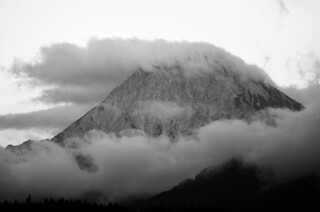
One typical picture is the Mittagskogel near my place. This photography was taken after I saw the impressive clouds while running. After reaching home, I went back to take this picture. Being quite unhappy with the result after editing I turned it into black and white and decided for this dramatic look.
The result was very well perceived by the flickr-community. What I wonder is if it really is this good? Does every photo look better if you elevate the contrast? Does every black and white picture is arty? What do you think?
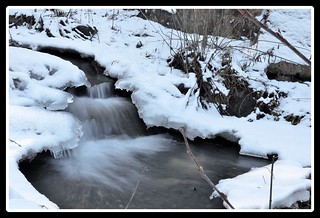
One thing fascinating me about photography is that you can take pictures in a way that they look different from what you would see with your bare eyes. One big lever you have is the exposure time. Fast shutter speed freezes everything in the movement and long shutter speed shows the way of every particle. A good objective for pictures like these are waterfalls. So after one month again (a bit after the last photo I featured here) and watching a few videos how to take waterfall pictures, I desperately wanted to shoot a waterfall. The problem was, I had no access to a permanently active waterfall. So I cycled along a river (Gail) hoping to spot at least a small one. You see, the one I found for sure was not impressive.
a small creek in the alps
I had only the kit lense, no tripod, no remote trigger, only free software available and absolutely no experience. Obviously also not the best motive. OK, you might see the photo is not the best, but in terms of flickr-interestingness it’s still very good. So what I did was using my backpack as tripod for the camera. Took pictures with very many different exposure times, if necessary with timer instead of remote trigger. At home I looked for the best of the pictures. Then I used my free editing tools to improve the quality. Compared different edits, cuts, compared colour to black and white, edited other of the pictures in the same way and compared again. Still not done I uploaded them to flickr and participated in different groups to judge the picture. At the end I spent many hours on a picture which is not terribly impressive. I still like it very much, because I know that there are very many details, which are tweaked to just what I wanted it to look like. I think it reaches a certain quality. And I think that it shows that with time and a bit of passion it’s possible to create respected pictures even as an amateur.
Arriving there I started taking photos with very many different exposure times.
Art and Technology, Photography and Fishtanks, Youtube and Twitter – in german and english, something of everything.